
Understanding a Pitcher's Plane of Rotation

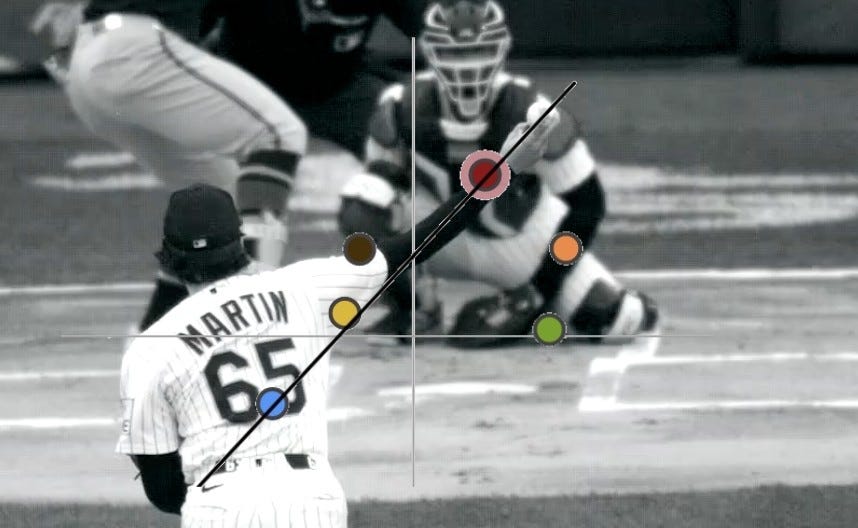
Arm slot is usually discussed as a category: Over-the-top, high three-quarter, low three-quarter, sidearm. These terms work fine in a report, but they describe where the arm ends up at release, not why or how it got there. It doesn’t say why one pitcher repeats that slot for 200 innings a year, or why forcing it breaks another guy down.
Plane of rotation explains this for us. It’s the axis the trunk rotates around as energy transfers up the kinetic chain, and it’s largely dictated by thoracic mobility, scapular positioning, and hip-shoulder separation. Arm slot is the byproduct of that plane; it’s what you see on video after the decision has already been made by the trunk. Identifying a pitcher’s natural plane, then building the delivery to rotate on it rather than fight it, is one of the higher-leverage decisions an athlete can make. This is the lowest-resistance path for rotational energy to reach the baseball.
What the Plane Actually Is
The plane of rotation is the geometric surface in space through which the arm travels during the throwing motion from maximum external rotation through acceleration and release. Every pitcher has one. It’s not a preference or a style choice, it’s anatomy: glenohumeral joint orientation and trunk tilt at foot strike do most of the work.
Trunk tilt is the primary setter of the plane. The amount of lateral flexion toward the glove side at foot plant sets the arm’s rotational arc. Less tilt toward the glove side flattens the arm path and opens horizontal movement shapes while more tilt creates the plane more vertical, favoring ride and downward break. The arm isn’t independently choosing its path — it’s following the plane the trunk set.
This matters because it means the arm slot is a downstream output of the delivery. Coaches who try to change arm slot by moving the arm are working backwards. The arm will go where the delivery puts it, and if the mechanics don’t support the desired slot, the arm will get there through compensation.
What Happens When a Pitcher Fights Their Plane
The glenohumeral joint has an efficient operating range, a window in which force transfers through the joint cleanly. A pitcher rotating through their natural plane loads and unloads the shoulder and elbow in the sequence those joints are built to handle. A pitcher moving against their plane, manipulating the arm path above or below the natural arc, loads those same joints at angles they weren’t built for.
Elbow valgus load is the clearest expression of this. It peaks just before and at maximum external rotation, and its magnitude depends heavily on how well the arm’s path lines up with the plane the trunk rotation has already established. When the arm diverges from that plane, the elbow absorbs more of the transition force, because the kinematic chain is no longer working fluidly. Part of the chain is compensating for another part.
This is the mechanism behind a too familiar coaching mistake of telling a pitcher to “get on top of the ball” when his delivery doesn’t support a high slot. The arm strains upward against a chain that’s built for a different plane, and the elbow takes on load the rest of the chain can’t absorb. What follows is a recognizable mechanical signature, forearm fly out, early supination, and an arm that drags through the zone. These aren’t separate flaws to correct individually, they’re downstream adaptations to the same underlying conflict.
Finding A Pitchers Plane of Rotation


This is where data becomes indispensable, because the natural plane is not always what the pitcher or coach thinks it is.
Not every program has a motion capture lab, but you don’t need one to get an estimate of a pitcher’s plane. Pull his Trackman movement plot, find his primary fastball and his breaking ball, and draw a line connecting them. That line is a reasonable stand-in for his plane of rotation. It’s the axis his release naturally organizes around, and pitchers tend to perform best when their other pitches correlate to that same line rather than requiring a different release characteristic to execute.
I want to reiterate, this is an inference, not a direct measurement. Grip and seam orientation shape the pitch, not just the body. For a coach without access to a lab it’s the most actionable read available, and it will usually get you close enough.
For those who do have access to more advanced technology:
High-speed video is the starting point and at this level, it should already be part of the workflow. At 1000+ frames per second, an Edgertronic or comparable setup lets you trace the actual arm path frame by frame, from max external rotation through acceleration and release. You’re not looking for a still image of a slot, you’re looking at whether the arm is tracking through the plane the trunk already set, or drifting off it.
Biomechanics capture is where this becomes measured. Trunk tilt at foot strike, shoulder abduction and horizontal abduction, both at foot strike and again at max external rotation, pelvis rotation timed against arm path. The numbers say the same thing: this is the plane the body actually built. Now the arm has something real to answer to. When the two line up, you leave it alone. When they don’t, you’re not describing a slot anymore you’re diagnosing a fault.
The pitch itself is also a signal. A pitcher’s natural plane largely determines which movement shapes are available to him without mechanical manipulation. A pitcher with a more neutral trunk tilt and a flatter plane is structurally positioned to generate arm-side run and sweeping horizontal break, these shapes are on his plane. A steep trunk angle and a more vertical plane is structurally positioned to generate a more vertical shaped arsenal. When a pitcher’s best pitches feel effortless and his secondary pitches feel manufactured, the ones that feel effortless are almost always the ones whose spin characteristics align with his natural plane. The manufactured ones are usually attempts to work off-plane.
The Deception and Design Implications
A pitcher rotating along his plane releases from a consistent window, same spatial point, same spin characteristics, pitch after pitch. Hitters don’t read the ball out of the hand; they read it out of the release window, and a stable window gives them nothing to pick up on. That consistency is the setup, not the deception. The deception is what’s built on top of it: movement shapes and velocity separation that tunnel off the same origin point and move late, after the swing decision is already made. That’s pitch design.
A pitcher fighting his plane can’t hold that window still, and hitters at every level learn to read what leaks out of the inconsistency, release height drifting pitch to pitch, the forearm flying out. None of that is subtle once a hitter’s seen it enough times and these are pre-release tells, they show up well before velocity or movement ever gets measured. An unstable plane leaks information for free, and hitters cash it in.
Coaching Application
Before you try changing an arm path, find the athlete’s plane. Movement plots, high-speed video, biomechanical data, whatever you have access to, use it to establish what plane this pitcher’s anatomy and delivery actually produce. Then ask is he rotating into that plane, or fighting it.
Most arm path problems get misdiagnosed as an arm problem. It rarely is. Fix the mechanical input that sets the plane, trunk tilt, hip-shoulder separation, lead leg block, whatever’s actually broken upstream. Or leave the plane alone and build the delivery around what it already is. Everything else is coaching the symptom instead of the cause.
Look at the pitchers who stay healthy and still throw hard deep into their careers. Almost without exception, their mechanics let them rotate freely through the same plane, pitch after pitch. That’s not luck, and it’s not a specific arm slot doing the work. It’s a chain that isn’t fighting itself. Energy reaches the baseball when the arm travels the path the body actually built for it, not the path a cue asked for.
Find the plane, rotate through it, build the arsenal on top of it.